
#2) THE CHANTING CONCEPT
The earliest vocalizations leading to speech were rhythmic, and accompanied by manual motions, both driven by the same rhythm (from Dr. Marcel Kinsbourne).

When we started to become conscious ~ like we are today, with the ability to hold concepts in mind ~ it seems likely to me that such an ability must have been initiated during the creation of a first word, which would link a well-known sound with an important culturally-shared experience. Maybe it was created by a happy accident during a fire-making ritual. Or maybe . . . it happened somewhere else . . .
Imagine you are a hominin ~ Homo erectus, perhaps ~ who does not yet think in words, but in images, living during the long millennia of the fire-making rituals occurring between 800,000 years ago (when first proof of fire occurs) and 500,000 years ago (when sudden changes to the tongue’s nerve and stone tools reveal that we had just acquired full language). The moving, ephemeral images that you as a hominin see in dreaming and when awake are the most strongly-imprinted images from the Ritual: the Leaders, the To-and-Fro Motion of making the fire, the sound of everyone’s Chanting, the Rod and Groove of the fire-making tool, the moment of Generation of the Fire bursting out of darkness, the contests of Opposition by the strongest among you, the masses of Valuable items surrounding the venue of the Ritual.
You see the gifts that you lovingly made and presented tonight. You are very aware of your hands, which have a creative power unlike that of any other animal. You think of yourself as the Hand Animal, and leave your name on rocks by blowing paint over your hand. “That’s me! I have been here!” You love to make things, turning grasses into baskets; turning entrails into braided cords; turning hides into cloaks, blankets, strong bags; turning stones into knives, hammers, shovels, grinding holes; turning stout sticks into hammers and deadly clubs and spears; stacking rocks to make oval shelters; shaping or choosing big rocks to make tables and chairs; cutting small trees and branches to make poles, then tying poles together to make storage platforms for your gathered foods . . .
The lunar-based fire-making Rituals are your supreme joy. You are especially good at visualizing the shapes and actions you know so well from those Rituals. Because you know these Ten Concepts so intimately, you know how to use them. The Rod and Groove of the fire-making tool you see in all rod-like and groove-like things ~ the ROD in straight branches for building, sticks for making spears, bones for making flutes and burins; and useful bending rods such as horns and cords; the GROOVE in rivers and the Great River ~ the Ocean, in all channels as those for bringing water and as gouged lines in rock to make images; long hollow things including boats, baskets, shoes, coffins, and all hollow things including grinding holes and caves. Fascinated by these ten Primary Concepts, you are becoming especially good at making images with lines: crosses, lattices, and recently many new images ~ goats (their fertility shown by the many seeds filling their bodies), chiefs wearing patterned cloaks, meat being divided into slices, checkered game boards, looms for weaving, yurts like our traders make back home in Mongolia.
And ONE THING makes its hidden power visible everywhere on land, sea and the sky ~ that is the POWER OF GENERATION. Everything is continually coming into visibility and going out again, like clouds, like shooting stars, like fire, like sea waves, like flowers. You are continually mind-blown by the magical appearances surrounding you. Your happiness is Plato’s true happiness which he says people have lost ~ a continual tangible pleasure bubbling up from your center and filling your whole body. Because you are able to be still, to be free of nervousness, knowing your tribe is healthy, and your Chiefs are strong.
And that’s just the beginning. Your human world consists especially of the fire-making times of CONGREGATING before your LEADERS (your Chief and Chieftess), and watching contests of OPPOSITION by the strongest ones among you. Also lately, you are adding some new members to your human world: the new animal dancers at the Rituals. Boy, how you love to watch them truly become the animals through their dancing! Now that is real GENERATION POWER! You are experiencing all these phenomena every month of your adult life. Your mind is full of culturally-shared “objective referents” just thirsting for language, which is ready to emerge to name them all.
~ ~
A word is an uttered sound, coded with unmistakable consonants in fixed order. Each word is culturally linked with an “objective referent” which can be mentally “shown” to another member of the same linguistic culture by uttering that word. It seems to me that the linking of a unique spoken sound with a conceptual referent had to be neurologically initiated, if not well established, before any more words could be devised. The fire-making rituals continuing for aeons of time, always with the same Primary Concepts visible and audible before the whole tribe, would provide an ample supply of deeply-embedded “objective referents” ~ yet without any idea about words to name them. Luckily for us humans, there was a single objective referent that everyone experienced and made vocal acknowledgement of: when the fire burst forth at the ritual, the chanting ended.
Visualize your beloved Chief energetically rubbing the fire-making Rod in time to the Chanting of the Gathered tribe. You are there, chanting AK-AK-AK-AK now and for the past several minutes in perfect unison with everyone. The final moment is almost upon us ~ because of some novel incendiaries in the mix, the fire is about to burst forth from the end of the Rod. (Wouldn’t Freud love this?). And then it happens! Spectacularly, and in multi-color! And at that precise moment, in perfect unison with the final thrust of the Rod, we all shout a single “a-KAAAAH!!!” and then drop silent.
Pity the poor adolescent attending his first Ritual with the adults, when he makes one too many a-kaa!s in the dead silence after the group’s grand finale. So many of us have done that same thing at our first Ritual. The laughter is warm-hearted, and the parents comfort the boy as much as possible. No worries, he will soon be craving the next Ritual as much as everyone does.
IN THE BEGINNING WAS THE WORD . . .
Around half a million years ago, as a member of the culture of the fire Ritual was out walking, he was shocked and surprised by a totally unexpected bursting forth of GENERATION POWER that would’ve knocked his sox off if he’d had any. Whether it was a shooting star, a nearby geyser erupting, an earthquake, a meteor hitting the earth ~ we don’t know. What we do know is this:
If the above scenario of the ending of the making of the fire is on the mark, the people who attended those rituals their whole lives would become conditioned to loudly utter A-KAAA! if suddenly exposed to huge impacts and appearances, sudden creations, of unique natural phenomena. And if right so far, then given the lengths of time we’re considering, isn’t it probable that a sudden natural appearance of generative power would eventually trigger an involuntary burst of “A-KAAAA!!!” from someone in the area?
And likewise in all probability, another person would (A) happen to be within earshot, and (B) would immediately look and see the same powerful manifestation, and (C) realize that the utterance came out of, and evokes, the Great Power of Generation, and finally (D) the First Word ~ A-KAA ~ would have happened.
The establishment of this utterance as the First Word is solidified by the fact that two people of the same culture both realized that it was the uttered “A-KAA” that instantly transferred the seeing of the Power of Generation from one person to the other. No one had ever done anything like that before! One might make a snoring sound, but that sound did not “say” snoring, it just “was” snoring. After the First Word happened, if one said A-KAA! it would be in reference to a manifestation of A-KAA as the hidden, powerful force of the generation of everything.
Thereafter, either one of the two people could confidently utter A-KAA! whenever he or she experienced a noteworthy manifestation of creative power, whether alone or with others of their tribe, assured by that mutually-confirmed first exchange that this uttering of A-KAA!, could let others see “the Divine” and join in the naming of it.
For that K-vowel-N sound to now appear as the initial root of words in all 40 languages, and for all of those 7,000+/- words to cascade into like-concept groupings that come together to illuminate their original venue as the fire=making ritual, it convinces me that this scenario is close to the truth, and that probabilities would eventually play out as spontaneously and appropriately uttered A-KAA! instigated a popular pastime of finding special manifestations of Creation and uttering AKAA in their wake. Something like this would of course rapidly spread the practice throughout that whole culture, and who knows how many cultures like it?
The /AKAA/ would become /KAN/ in the process of naming the ultra-Khan-charged Primary Concepts, named by adding further vocalizations to the end of /KAN/, possibly soon after the labial proto-consonant emerged “about half a million years ago.” The First Language (made solely with /K/ and vowels) could thereby incorporate labial consonants, and the Mother Tongue, essential to ocean-spanning traders, would begin to appear soon thereafter. The Coso Range petroglyphs would be created in the joyful celebration of the vastly successful cashmere industry the folks there were conducting, made possible by ice-age meltwaters (but which ice age?) filling much of the Great Basin.
Another necessary attribute of speech would be the capability of stringing numerous words together without losing sight of the understandable referents being alluded to. Some of this skill would surely have been neurologically initiated by the lengthy chanting at the Rituals. But think of sailors trying to command ships with a language made of just one consonant, possibly adding a nasal quasi=consonant. (Did Captain say, “Drop the anchor,” or “Drop Andrew overboard?”) During the time that the First Language was being tried at sea, there must’ve been incredible stress put on proper enunciation and syntax. One mistaken word could be fatal to all. Such conditioning surely carried over, at least somewhat, to the Mother Tongue, bringing with it already-firm grammatical order and other conventions.
It is the repeated exposure to experiences that brings about familiar recognition of them, and paves the way for applying names to them. Right-left-brain theorists say that when new experiences attain this level of familiarity, the sensations they cause rapidly go to the LEFT BRAIN in coded fashion, so not to take up as much conceptual “room” as brand new experiences do. Fresh new experiences are explored and tasted more slowly in the RIGHT BRAIN, they explain.
Art instructors are strong on right-brain experiences, which tend to foster the production of “good” art, i.e., new ways of seeing and more deeply appreciating the subject of the art. (See Drawing on the Right Side of the Brain by Betty Edwards.) Some of the most truly eloquent public speaking I’ve heard has been speeches given at the Bakersfield Museum of Art by accomplished artists about their art, Each speech is uniquely different from all others ~ no canned phrases in any of them. What is evident in all their speeches is the mental outlook of the artists, achieved through lifelong practice of looking freshly at each turn of events, and how it shaped their lives and their art.
When our hominin ancestors were spending their lives strongly anticipating the next Ritual, and making gifts and collecting treasures for their Chiefs, as the years passed they would gain more and more ability to recall aspects of those rituals in visual imagery. The ten Primary Concepts would mentally boil around in their eagerness to return to the Ritual ~ RODS, GROOVES, CHANTING, FIRE/BRIGHTNESS, VALUABLES, LEADERS, OPPOSITION, CONGREGATING, RHYTHMIC/TO-AND-FRO MOTION, with the POWER OF GENERATION (Khan) permeating all of them.
One thing is beyond conjecture, which is that as soon as the labial proto-consonant was born, its versatility would quickly develop into utterances naming the Nine Primary Concepts that had been lovingly longed for in eagerness for the next Ritual. Some of the Sub-Clusters of experience within each Primary Concept would also acquire labial-consonant-aided names. Eventually, all 208 /K-vowel-N/ concepts herein called “Meaning Groups” acquired names as well. Those names all began with /KVN/, a fact which is made evident in the Russian language, wherein the initial /KA/ was dropped and all 208 Meaning Group concepts now begin with letter N.
A woman who was hypnotically regressed said she “Went all the way back to when we were fire worshippers. We were silent most of the time. It was only during fire worshipping that we really came alive.” (I think she could just as well have said “only during fire worshipping did we really come awake” ~ i.e., conscious.) This corresponds neatly with the picture emerging from our Primary Concepts, a picture indicating the origins of conceptualization within ritualized fire-making. The Primary Concepts gave rise to the concepts here called “Sub-Clusters”. The Sub-Clusters in turn gave rise to the 208 concepts of the Mother Tongue, which diversified when the Mother Tongue did, into the world’s various languages. In each language, the /KVN/ words are what reveal the central concept of each Meaning Group, a concept solid enough that it can be assuredly seen as the original concept behind its variations in today’s modern words.
Let’s look at the specific concepts arising from our earliest CHANTING. Their Sub-Clusters and Meaning Groups will be noted for the number of KVN ('/K-vowel-N/) words in their largest groupings. Since I collected all the KVN-based words in the dictionaries of 40 languages, it is meaningful to compare the proportional sizes all the KVN groupings, and some of the other two proto-consonants’.
As one example from my second book, “Volume II,” containing the labial-proto-consonant patterns, there is an inordinately large Meaning Group in the Stone Working Primary Concept, which by its size proves that Meaning Group did not spread the same way that all the others did. Rather, the size of a single metaphor referred to in that one Meaning Group, which would have had a profound impact on all hunter-gatherer cultures at the time, I know it MUST have been spread by song, and by just one song with endlessly new versions.
CHANTING ~ ITS SUBCLUSTERS & MEANING GROUPS
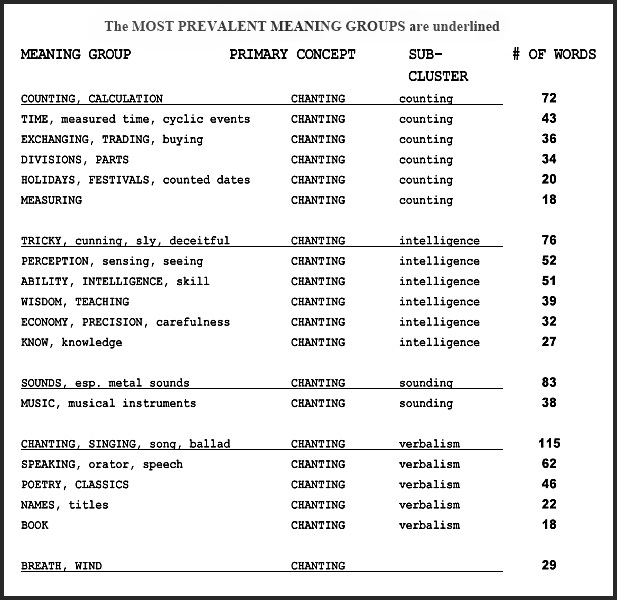
For a downloadable legible copy, please click on the above table.
In the above table we see that in the CHANTING Primary Concept, the largest Sub-Cluster is VERBALISM, with 323 KVN words, and VERBALISM’S largest Meaning Group is “CHANTING, SINGING” with 115 KVN words. Clearly people at this time (“about half a million years ago”) were loving their newfound speech capability made possible by the versatile labial proto-consonant, most especially in song and poetry, as well as in oratory, which could include story-telling. Now, as never before, words could be invented imaginatively rather than adhering religiously to a first syllable.
Next largest Sub-Cluster of Chanting is INTELLIGENCE with 277 KVN words. The most talked-about Meaning Group here is TRICKY, with 76 KVN words. Also much talked about are the Meaning Groups PERCEPTION, and ABILITY/INTELLIGENCE.
The thirdly-most represented Sub-Cluster of Chanting is COUNTING, with 223 words, including the top Meaning Group COUNTING, CALCULATION with 72 words. The COUNTING Sub-Cluster also contains the interesting Meaning Groups Time; Exchanging/Trading; Divisions/Parts; Holidays/Festivals (see chart below) and Measuring.
So far, all the Sub-Clusters are concerned with various conceptual and spoken activities and capabilities. The most meagerly-represented CHANTING Sub-Cluster, SOUNDING with 121 words in two Meaning Groups, does not contain references to anything verbal or conceptual. Its two Meaning Groups are Sounds and Music. The sizes of these contrast starkly with the huge Meaning Group “CHANTING, SINGING, song, ballad” which contains over 1/3rd of all the words in the VERBALISM Sub-Cluster of the CHANTING Primary Concept, attesting to people’s enchantment with conceptual utterances over non-conceptual sounds, even lovely music.
Finally, a single Meaning Group, BREATH/WIND, stands alone. Though it is involved in speech, only one of its individual words has a hint of connection with the breath of speech. That one is a Japanese word meaning “be exposed to severe criticism”, Rather, in six languages ~ Cornish, Ancient Egyptian, Irish, Japanese, Maori and Welsh ~ all other references of the BREATH/WIND concept are to smelling, odor, breath, and wind.
I’d like to end with an example of a Meaning Group ~ HOLIDAYS, FESTIVALS ~ in the CHANTING Primary Concept’s COUNTING Sub-Cluster:
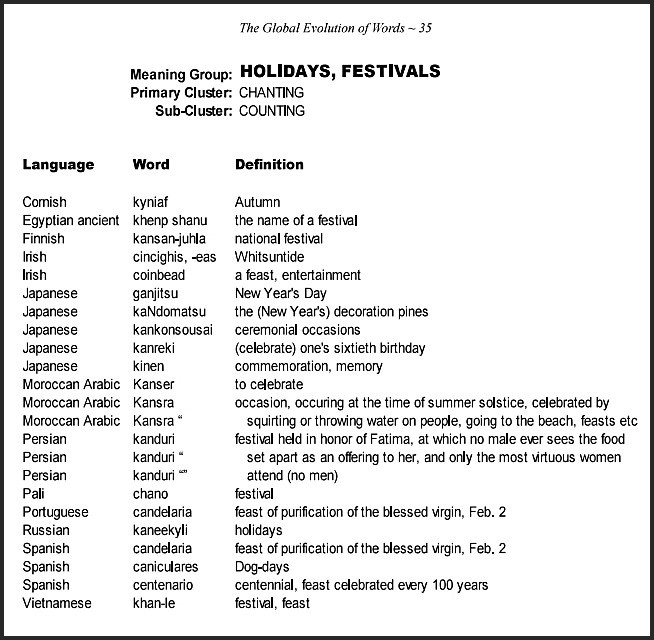
For a downloadable legible copy, please click on the above table.
Everyone, please feel free to . . .
Warmest regards,
Kim Salisbury
Bodfish, California, USA